Upload a list. The agent opens the conversation — and keeps it going.
Past leads, event sign-ups, pre-approved customers, a launch base, owners due for a service. The agent reaches out on WhatsApp or by phone with an approved message, answers whatever comes back, follows up on your cadence, and stops the moment someone says no.
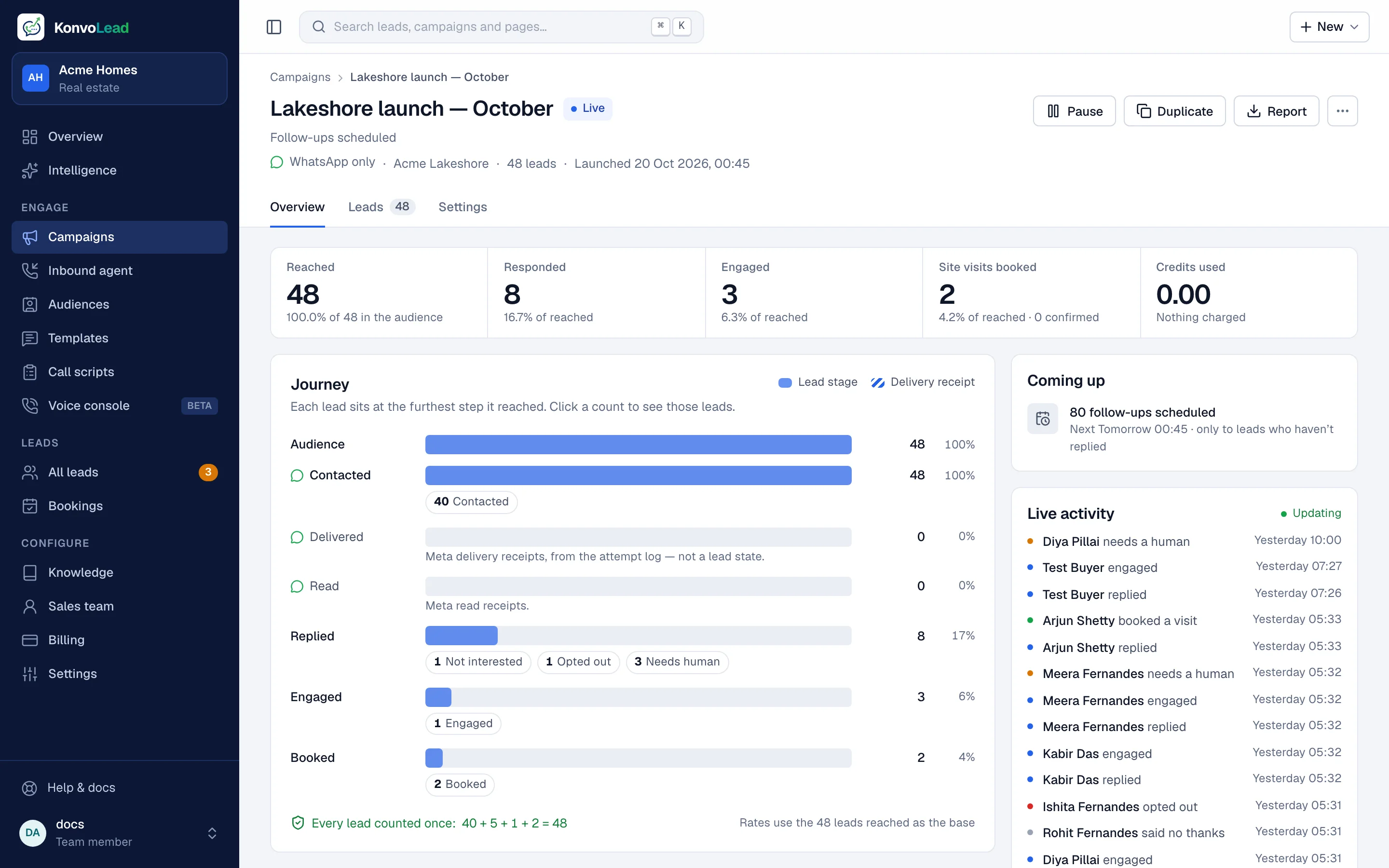
From a spreadsheet to conversations with outcomes.
- Audience. Upload a list with the basis on which those people agreed to hear from you; duplicates, opt-outs and bad numbers are handled at import.
- Approved message. Pick a Meta-approved WhatsApp template or write the spoken opener. Personalised per lead from your file.
- Pacing. Send window, daily cap, throttle, calling hours — in your time zone, with a cross-campaign cooldown.
- The conversation. Every reply is answered by the agent. Interested leads get a booking request or a handoff; the rest get followed up.
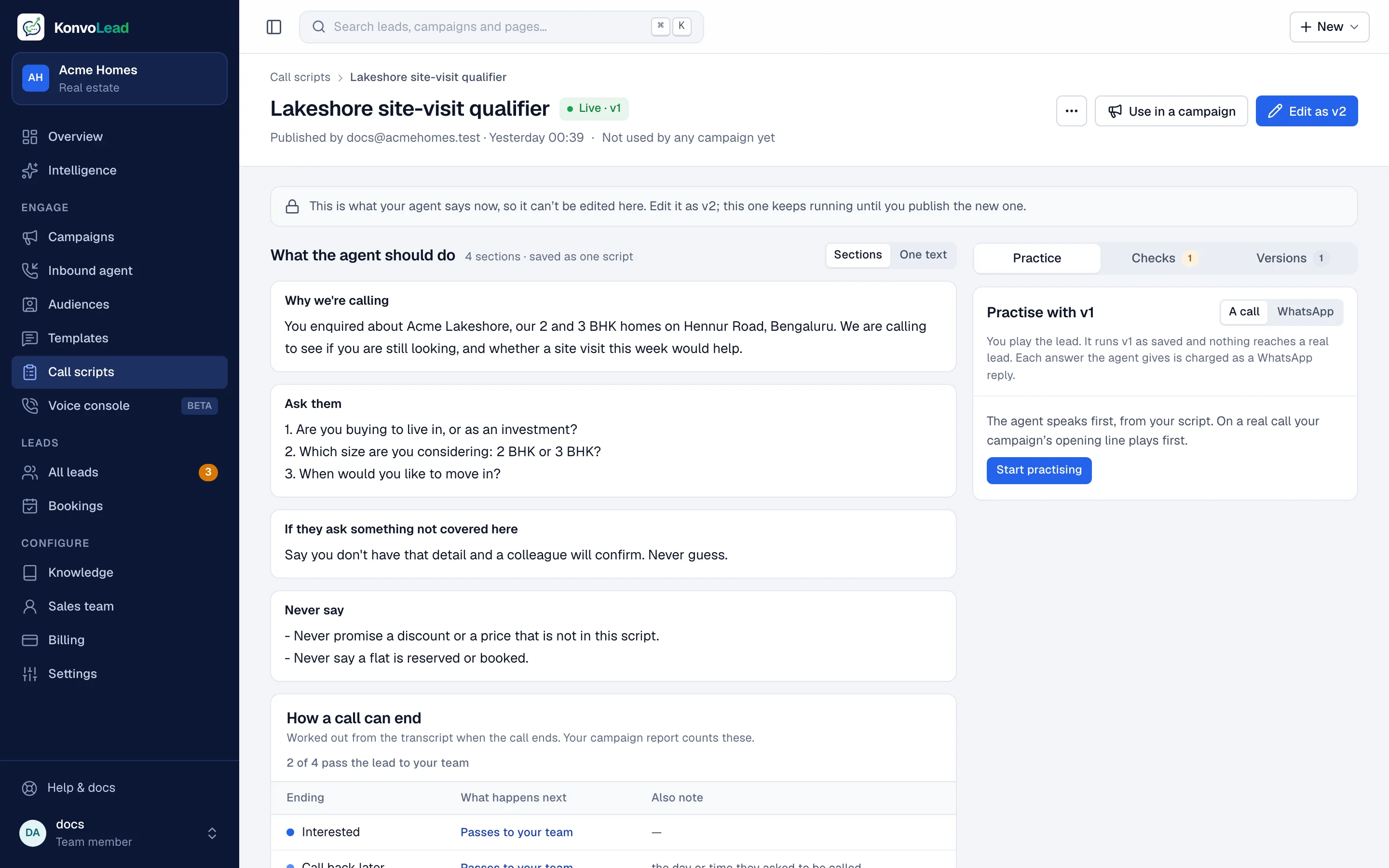
Answer everything, or ask a few questions and pass on the interested.
Choose per campaign. Both run on the same channels, the same safety rails and the same handoff.
- Knowledge agent. Answers any question about a project, product or model from the verified facts you gave it, qualifies, and requests the next step.
- Qualifying agent. Works only from a call script you write — who you are, what to ask, what never to say — and the customer details you switch on, and hands anyone interested straight to your team. No knowledge base needed: it is what dealerships use for service reminders.
- Selling lines. For the qualifying agent: lines that apply only when a customer’s own data says so — “car older than 10 years”, “has loyalty points” — chosen by rules, never by the model.
WhatsApp, voice, or one then the other.
Each campaign chooses how it uses its channels — and the switch happens automatically for the leads that do not respond.
WhatsApp only
Template opener, agent conversation, follow-ups.
Voice only
A spoken opener by the agent; the conversation happens on the call. Unanswered numbers are tried again on a ladder you set.
WhatsApp, then voice
Message first; after your switch window, call the ones who did not reply.
Voice, then WhatsApp
Call first; the unreachable get a message.
Persistent without being a nuisance.
“No thanks” is not “stop”
A decline ends this campaign and nothing else; an opt-out is honoured on every channel, forever. Both are understood in plain language, not just the STOP keyword.
Contact cooldown
A lead in two campaigns is never messaged twice in a week; a lead mid-conversation with your team is never interrupted by a campaign.
Your hours only
Nothing sends or dials outside the window you set, and calls stay inside a 9 am to 9 pm floor whatever the window says.
Machines are not pitched
A voicemail greeting or a call-screening assistant is recognised, the call ends cleanly, and the number is tried again later.
A funnel per channel, attributed per campaign.
Audience → contacted → replied → engaged → booked, split by WhatsApp and voice, with declines, opt-outs and unreachables counted honestly rather than lumped into “no response”. Every lead sits in exactly one place and the page shows its own arithmetic.
Do I need Meta-approved templates?
For WhatsApp openers, yes — that is WhatsApp’s rule for messaging someone first. The dashboard has a library of approved-style templates and a guided form for custom ones; we submit them to Meta for you.
What happens when someone replies weeks later?
The same agent picks the conversation up, with the campaign context. Every reply is attributed to the campaign that actually reached them.
Can I run several campaigns at once?
Yes. The contact cooldown makes sure a lead who is in two does not hear from both in the same week.
How does the agent introduce itself on a call?
With the opening line you wrote and approved — the product adds nothing to it. If your policy requires the caller to be told they are speaking to an AI assistant, you put that in the opener and it is said on every call.
See Outbound on your own material.
A 20-minute walkthrough — chat first, then a call.